View Invariant Learning for Vision-Language Navigation in Continuous Environments

Josh Qixuan Sun1*, Huaiyuan Weng2, Xiaoying Xing3, Chul Min Yeum2, Mark Crowley1
1 Department of Electrical and Computer Engineering, University of Waterloo, Canada
2 Department of Civil and Environmental Engineering, University of Waterloo, Canada
3 Department of Electrical and Computer Engineering, Northwestern University, USA
* Corresponding Author
Accepted to IEEE Robotics and Automation Letters (RA-L) 2026
Presented at IROS 2026.

IROS 2026 Poster

Abstract

Vision-Language Navigation in Continuous Environments (VLNCE), where an agent follows instructions and moves freely to reach a destination, is a key research problem in embodied AI. However, most existing approaches are sensitive to viewpoint changes, i.e. variations in camera height and viewing angle. Here we introduce a more general scenario, V²-VLNCE (VLNCE with Varied Viewpoints) and propose a view-invariant post-training framework, called VIL (View Invariant Learning), that makes existing navigation policies more robust to changes in camera viewpoint. VIL employs a contrastive learning framework to learn sparse and view-invariant features. We also introduce a teacher-student framework for the Waypoint Predictor Module, where a view-dependent teacher model distills knowledge into a view-invariant student model. Empirical results show that our method outperforms state-of-the-art approaches on V²-VLNCE by 8–15% measured on Success Rate for R2R-CE and RxR-CE. We further evaluate VIL on simulated robot camera placements and real-world robot navigation, showing consistent improvements in robustness.

V²-VLNCE Benchmark

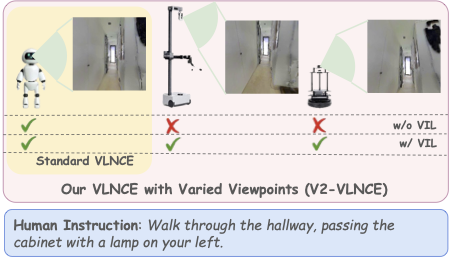
The Varied Viewpoint challenge occurs when agents must generalize across environments with different egocentric camera placements, which is common in real-world robotics due to differences in sensor mounting. To systematically study this problem, we introduce V²-VLNCE (VLNCE with Varied Viewpoints), a generalized evaluation setting designed to measure navigation performance under diverse camera viewpoints.

We focus on two viewpoint variables: camera height and camera angle. For each navigation episode, a viewpoint is sampled from a two-dimensional distribution over height and angle ranges. This design better reflects realistic deployment conditions compared to fixed-viewpoint VLNCE settings.

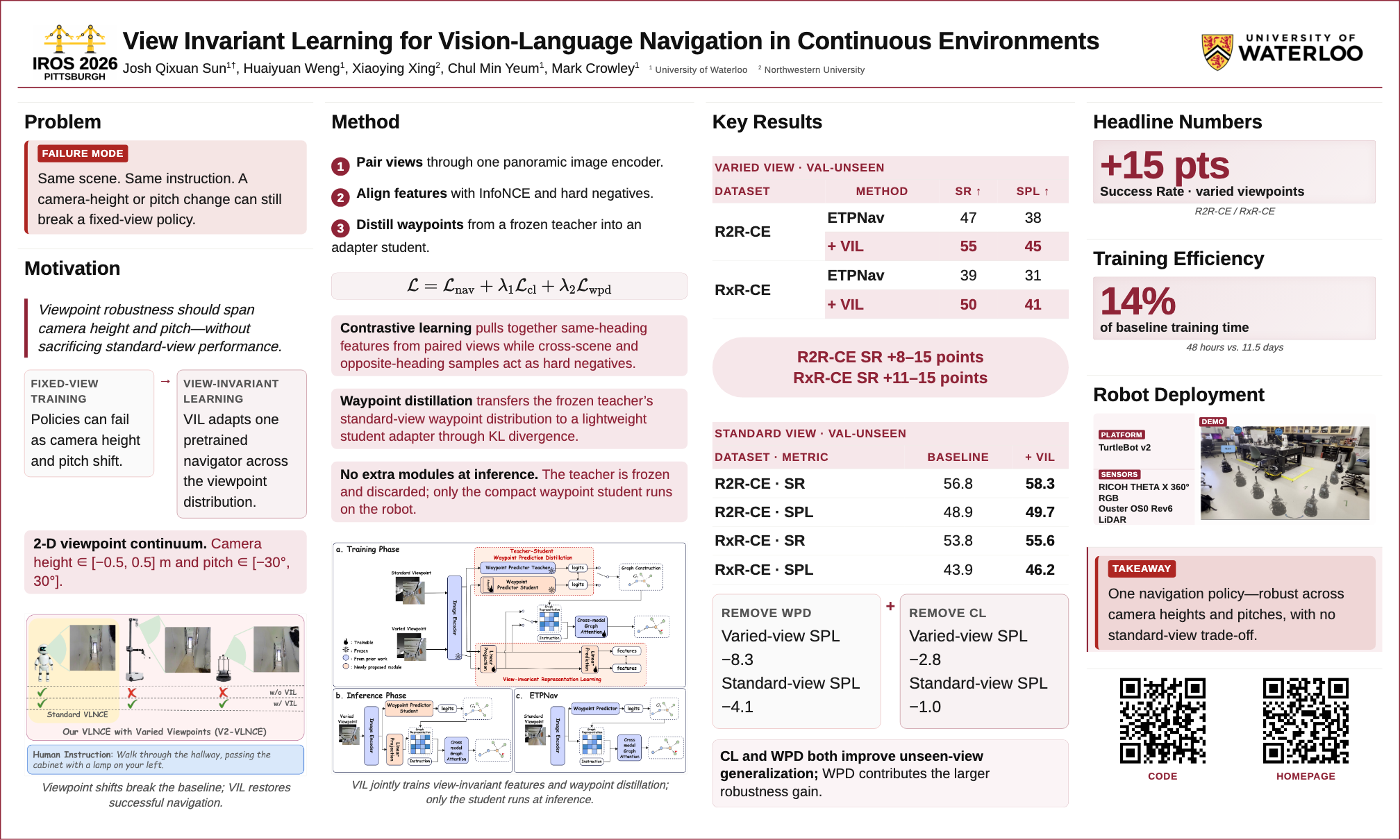
Comparison between standard VLNCE and our proposed V²-VLNCE. Under viewpoint changes, baseline navigation policies suffer from degraded performance. Applying View Invariant Learning (VIL) improves robustness and enables stable navigation across varied viewpoints.

Approach

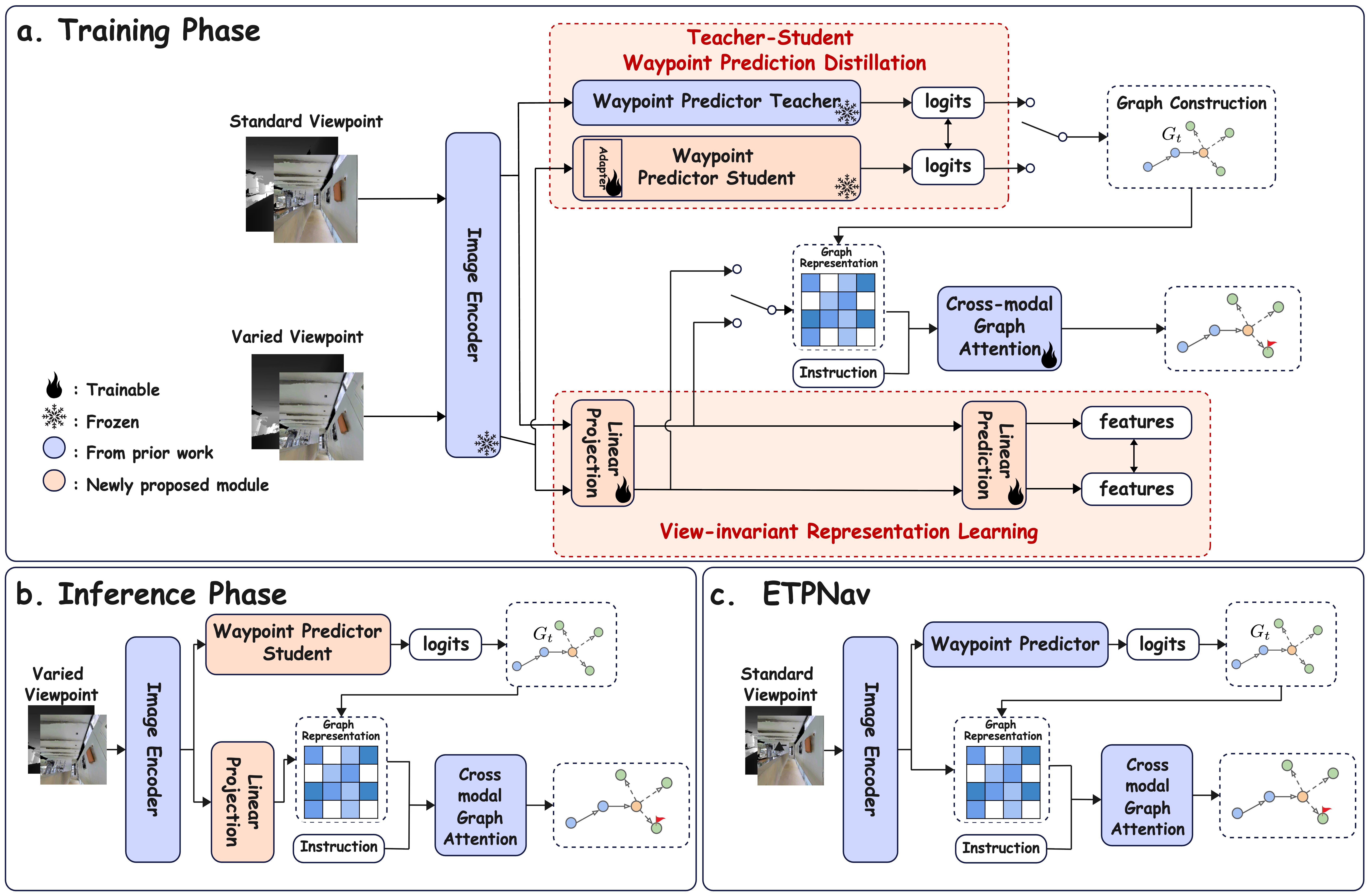
We propose View Invariant Learning (VIL), a strategy that adapts existing navigation policies to varied viewpoints without retraining from scratch. VIL contains two components: a contrastive learning objective and a teacher-student framework for waypoint prediction.

The contrastive component encourages sparse and view-invariant representations by aligning observations of the same scene captured from different viewpoints while separating unrelated observations. Features for contrastive learning are produced by a projection head and are shared with the navigation policy.

For waypoint prediction, a frozen teacher model, initialized from a pretrained navigation policy, processes observations from a standard viewpoint. The student model shares the same architecture but trains only a lightweight adapter inserted into the waypoint predictor while keeping the remaining parameters frozen. The student receives varied-viewpoint observations and learns to match the teacher outputs through a distillation loss.

Both components are optimized jointly in an end-to-end manner, enabling efficient adaptation to viewpoint variation while preserving the original navigation capability.

Quantitive Results

Results on V²-VLNCE

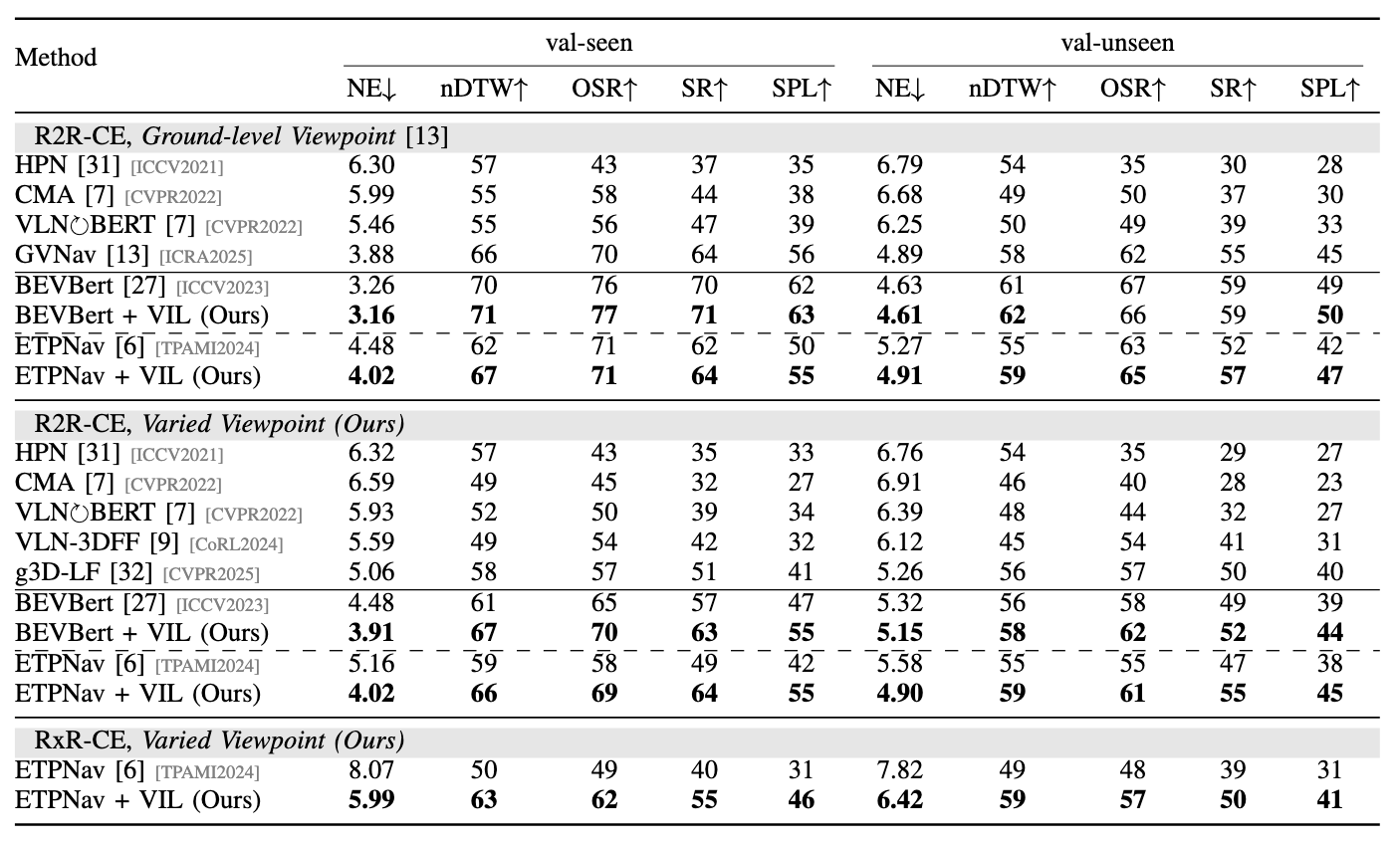
Comparison on R2R-CE and RxR-CE under the Varied Viewpoint and Ground-level Viewpoint settings. The Varied Viewpoint setting corresponds to our proposed V²-VLNCE setup. The Ground-level Viewpoint setting is adapted from GVNav. Evaluation metrics are consistent with GVNav. Bold indicates performance improvements introduced by VIL.

Results on VLNCE

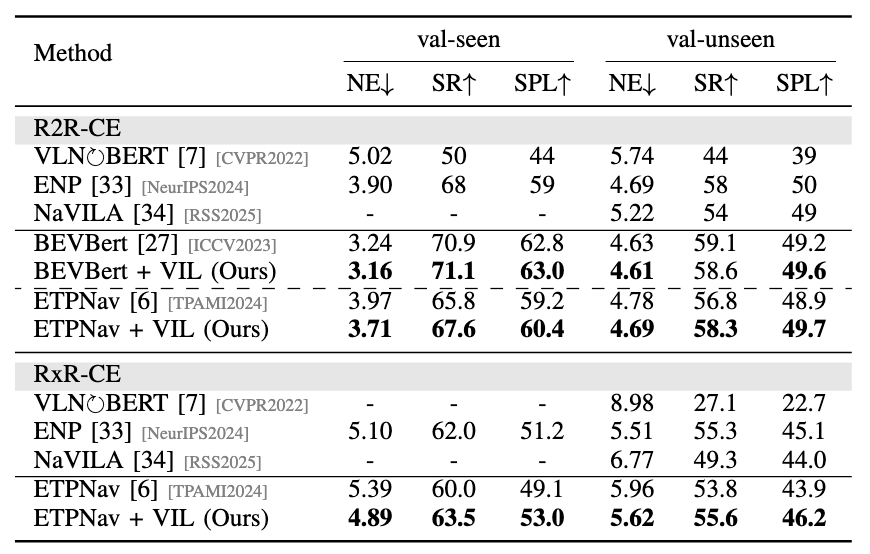
Performance under standard viewpoint (VLNCE).

Qualitative Comparisons

Camera viewpoint (position) configuration: From the perspective of a Stretch RE-1 robot. View: Due to the geometric variations in camera height and pitch angle, all videos display the Front-View (egocentric RGB) to provide the most accurate representation of the agent's visual input.

ETPNav vs VIL-ETPNav

Case 1 — ETPNav

Case 1 — VIL-ETPNav

Case 2 — ETPNav

Case 2 — VIL-ETPNav

Case 3 — ETPNav

Case 3 — VIL-ETPNav

BEVBert vs VIL-BEVBert

Case 4 — BEVBert

Case 4 — VIL-BEVBert

Case 5 — BEVBert

Case 5 — VIL-BEVBert

Case 6 — BEVBert

Case 6 — VIL-BEVBert

BibTeX

@ARTICLE{11419772,
  author={Sun, Josh Qixuan and Weng, Huaiyuan and Xing, Xiaoying and Yeum, Chul Min and Crowley, Mark},
  journal={IEEE Robotics and Automation Letters},
  title={View Invariant Learning for Vision-Language Navigation in Continuous Environments},
  year={2026},
  volume={11},
  number={5},
  pages={5861-5868},
  doi={10.1109/LRA.2026.3669785}}